#include <Sound.h>
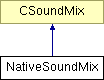
Class diagram for NativeSoundMix:
Public Members | |||
 | | virtual void | NativeConstruct () |
| | virtual void | NativeDestruct () |
| | virtual void | EnterCritical () |
| | virtual void | LeaveCritical () |
| | virtual void | BuildAndWrite ( WaveHeader* hdr, BOOL silence ) |
| | virtual void | GetNativeSoundCap ( S32* format ) |
| | virtual BOOL | OpenNativeDevice ( CSound* format ) |
| | virtual void | BuffersReady () |
| | virtual void | BuffersUpdated () |
| | virtual void | CloseNativeDevice () |
| | virtual BOOL | IsDeviceOpen () |
[virtual]
CSoundMix does not use a contructor. For compatibility with CSoundMix, NativeConstruct is called for object "construction."
Reimplemented from CSoundMix.
[virtual]
CSoundMix does not use a destructor. For compatibility with CSoundMix, NativeDestruct is called for object "destruction."
Reimplemented from CSoundMix.
[virtual]
The sound data needs to be protected is multi-threaded systems. Only one thread can have the critical semaphor. This call requests, and blocks, access to the critical sound semaphor.
Reimplemented from CSoundMix.
[virtual]
BuildAndWrite is passed the WaveHeader to an available buffer. It should call BuildBuffer to repack the buffer and then send the buffer to the hardware device. If silence is true, BuildBuffer should not be called, and BuildAndWrite should write silence to the buffer and send it to the hardware.
BuildAndWrite is called from core code when the device is opened, and called by the Native code when a buffer completes playing.
Reimplemented from CSoundMix.
[virtual]
GetNativeSoundCap gets the best native sound format. Called inside a critical section, when the hardware device is closed. This format is OR'd from the following variables:
sndMono, sndStereo
snd8Bit, snd16Bit
snd5K, snd11K, snd22K, snd44K
Reimplemented from CSoundMix.
[virtual]
Opens the hardware device in the given format. This call should not change CSound* format.
Reimplemented from CSoundMix.
[virtual]
BuffersReady is called when the device is open, the buffers are allocated, and the buffers are filled with data. A signal to start playing sound.
Reimplemented from CSoundMix.
[virtual]
When the buffers are allocated or enlarged, BuffersUpdated is called to inform the native code.
Reimplemented from CSoundMix.
[virtual] [virtual]
Queries the state of the hardware device. Should be a fast call - it may be prudent to buffer the device state rather than actually asking the device.
Reimplemented from CSoundMix.